
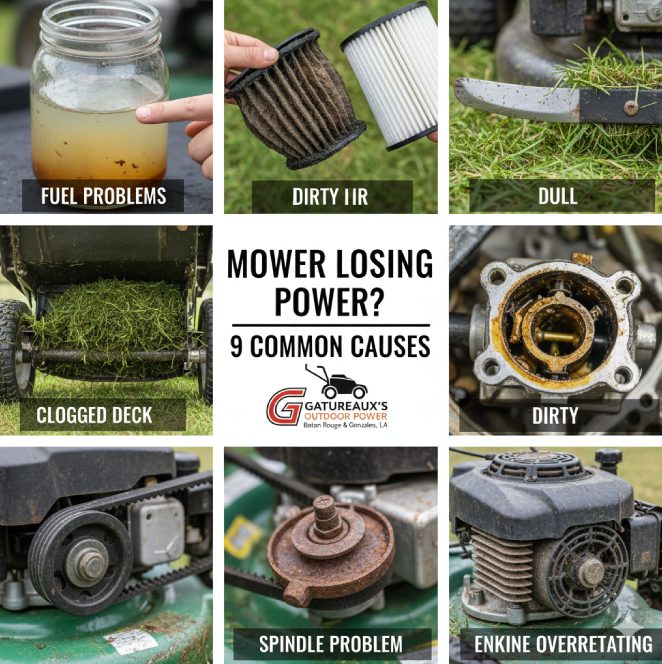
Preventing Your Lawn Mower Losing Power Under Load
If your lawn mower starts strong but then loses power once you hit thick grass, you’re not alone. With the thick turf, high humidity, and long growing season in Louisiana, this is one of the most common issues that homeowners encounter.
Fortunately, most issues are simple and, when taken care of promptly, can help avoid more expensive and complex repairs. We’ve put together a complete guide to diagnosing, repairing, and preventing those issues in your own backyard!
The Usual Suspects
Almost always, the mower losing power boils down to a handful of common causes – these are our “usual suspects.”
1. Fuel Problems
For starters, improper or aged fuel is one of the most common inhibitors to a mower functioning correctly. Modern gasoline degrades quickly, especially in the Louisiana heat. If your fuel is old or contaminated, it can’t combust efficiently, which then causes the engine to choke on those thick patches of grass.
To fix it, follow these four steps in order:
- Drain the old/contaminated fuel
- Replace it with fresh, ethanol-free gasoline
- Add a fuel system cleaner
- If the fuel filter is clogged, replace it
2. Dirty Air Suffocating the Engine
A clogged air filter is also a regular issue, causing the engine to run too rich (too much fuel, not enough air). The workload increasing – whether by way of increased time or more difficult terrain – can further exacerbate the problem. Again, the heat in Louisiana – as well as dust, humidity, and thick grass debris – clog filters much faster than you’d think.
This hangup, thankfully, is one of the easiest to fix. Depending on your filter type, adhere to the following steps to get your mower back up and running.
- Replace paper air filters entirely
- Wash foam filters with soap – then, dry and re-oil
- With dual-element filters, clean the foam and replace the paper
3. Dull or Damaged Blades
If your mower loses power specifically when the blade is put to use, this is a strong sign that your problem lies in dull or damaged blades. Faulty blades rip grass instead of cutting it cleanly, creating a resistance that forces your engine to work harder, and may result in it losing power entirely.
Avoiding this issue comes down to three simple steps:
- Sharpen your mower blades after every 8–10 hours of use
- Replace bent or damaged blades immediately
- Ensure your blades are balanced (evenly distributed weight)
4. Clogged Mower Deck
Dealing with a clogged mower deck is extremely common, especially during rainy weeks or when cutting St. Augustine or Bermuda grass specifically. Wet grass clumps often stick to the underside of the deck, reducing airflow and causing the blade to slow down as a result.
In this case, do the following:
- Remove compacted grass from the deck
- Scrape and clean the deck thoroughly
- Apply a non-stick coating or WD-40 to prevent future buildup
5. Carburetor is Dirty or Misadjusted
If your mower consistently surges, stalls, or bogs down, the carburetor may not be delivering the right air/fuel mixture. Ethanol-heavy gas can clog up jets and passages. This issue becomes especially commonplace when a mower sits idle for longer periods of time.
If you haven’t used your mower in weeks, this could be your problem. The fix is relatively simple.
- Add carburetor cleaner to new, fresh fuel
- Clean the carburetor bowl
- If the carburetor is heavily varnished/gummed, rebuild it
6. Belt is Worn/Slipping
On zero-turns and riding mowers especially, a worn or slipping belt is often the reason for power loss under load. A loose or worn belt reduces a blade’s speed, causing the mower to lose power when attempting to cut thick grass.
To prevent this problem, adhere to these three steps:
- Check the belt for glazing, cracking, fraying
- If the belt is in good condition, tighten it
- If the belt is in worn/bad condition, replace it
- Inspect tensioner pulleys for proper tension and alignment
7. Spindle or Pulley Problems
A failing spindle assembly creates drag, friction, and resistance, which causes the mower to lose power when the blades engage. If you hear a grinding noise, feel excess vibration, or if the blade drags when you rotate it by hand, a spindle/pulley fault is likely to blame.
The fix:
- Replace spindle bearings
- Re-grease fittings (if applicable)
- If the spindle assembly is worn, replace it
8. Engine Overheating
Overheating reduces engine efficiency and can cause the mower to bog down. This can happen for a variety of reasons, such as clogged cooling fans, old engine oil, a restricted airflow and attempting to cut wet, tall or thick grass.
Follow these four steps to stop your engine from overheating:
- Clean the engine’s cooling system
- Change the oil
- Avoid mowing wet grass, if possible
- Maintain proper mower deck airflow (see No. 4)
9. Low Compression
Low compression is a less common inhibitor, though equally as serious as the previous problems on this list. If your mower is dealing with hard starting, rapid power loss or knocking sounds, low compression could be the culprit.
Often caused by worn valves, a worn cylinder and potentially even a blown head gasket, this issue requires professional repair.
Restoring Power to your Mower
A mower losing power under load is almost always a symptom, not the core problem. Identifying the root cause early can save you from expensive repairs later. Start with simpler checks, such as air filter, fuel quality, the blades and the spark plug. If the issue persists, your local repair shop can diagnose deeper issues and get your equipment running smoothly again.
If you’re still having trouble getting your mower to run properly again, Gautreaux’s Outdoor Power services all major brands; Hustler, Gravely, Toro, Cub Cadet and more! We handle blade sharpening, carb cleaning, belt replacement, deck repair and full engine diagnostics, too.
You can visit us in Baton Rouge or Gonzales for expert mower repair!