
How Long Does a 3.0Ah Battery Last on an Electric Lawnmower?
Key Takeaways / TL;DR
The runtime of a 3.0Ah battery in an electric lawnmower is highly variable, but for an average residential lawnmower (around 40V to 80V systems), a 3.0Ah battery will typically last between 20 and 40 minutes of continuous mowing. This is generally enough to cover a small to medium-sized yard (about 1/8 to 1/4 acre). The precise runtime depends on several critical factors, including the mower’s voltage, the lawn conditions (grass height and wetness), and the mower’s power management system.
What You Need to Know: Understanding 3.0Ah Battery Runtime
How long does a 3.0Ah battery last on an electric lawnmower? A 3.0 Amp-hour (Ah) battery on an electric lawnmower generally provides 20 to 40 minutes of practical runtime.
Amp-hours (Ah) measure the battery’s capacity—how much energy it can store. However, capacity alone doesn’t dictate runtime. The mower’s voltage (V) is equally important, as it determines the rate at which that energy is used (power). Higher voltage systems (like 80V) deliver more power but consume the Ah capacity faster, especially under heavy load.
Here are the key factors that cause this wide runtime variation:
- Mower Voltage System (V):
- Low to Mid-Range (36V/40V): A 3.0Ah battery on a 40V system typically offers longer runtimes, sometimes up to the 40-minute mark, suitable for lighter mowing tasks.
- High-Power (80V): A 3.0Ah battery on an 80V system will have a shorter runtime, often closer to 20-25 minutes, but will deliver significantly more cutting power for thicker or taller grass.
- Grass Conditions and Mowing Habits:
- Grass Height/Thickness: Taller, thicker grass requires the motor to work harder, drawing more amps and drastically reducing runtime.
- Mulching vs. Bagging: Mulching requires more energy than side-discharging or bagging, as the mower has to cut the clippings multiple times.
- Self-Propelled Feature: Using the self-propelled function consumes additional battery power, reducing your mowing time.
- Battery Age and Temperature:
- Aging: As a lithium-ion battery ages, its maximum capacity (Ah) naturally decreases.
- Heat: Extreme heat during operation can temporarily reduce performance and long-term lifespan.
Key Facts About 3.0Ah Lawnmower Batteries
|
Feature |
Average Performance Metric |
Why It Matters for Runtime |
|
Typical Runtime |
20–40 minutes |
This is your realistic window for continuous mowing. |
|
Area Covered |
≈ 1/8 to 1/4 acre |
Enough for most small suburban yards in a single charge. |
|
Voltage Effect |
Higher Voltage (V) = Shorter Runtime (for the same Ah) |
More power for tough cuts means quicker energy consumption. |
|
Charge Time |
60–90 minutes (with a fast charger) |
Quick turnaround allows for timely battery swaps for larger yards. |
The Real-World Runtime Calculation
To truly understand how long your specific 3.0Ah battery will last, you need to consider the load the motor is under. Electric lawnmowers rarely draw a constant amount of power.
The Simplified Power Formula
Power (Watts) ≈ Voltage (Volts) × Current (Amps)
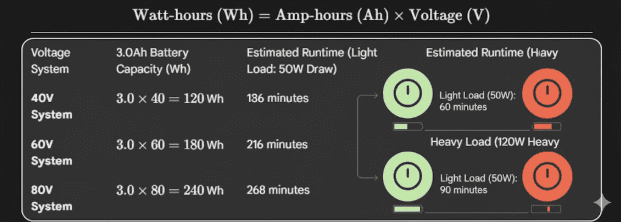
The battery’s energy is measured in Watt-hours (Wh), which is a better gauge of total available energy than just Ah.
Watt-hours (Wh)=Amp-hours (Ah)×Voltage (V)
|
Voltage System |
3.0Ah Battery Capacity (Wh) |
Estimated Runtime (Light Load: 50W Draw) |
Estimated Runtime (Heavy Load: 120W Draw) |
|
40V System |
3.0×40=120 Wh |
144 minutes |
60 minutes |
|
60V System |
3.0×60=180 Wh |
216 minutes |
90 minutes |
|
80V System |
3.0×80=240 Wh |
288 minutes |
120 minutes |
Disclaimer on Table: The theoretical runtimes listed above are based on ideal, continuous power draw and do not account for motor efficiency, peak power demands (like hitting a thick patch), or the power lost to heat. Real-world lawnmower operation is far more demanding. For instance, a lawnmower under typical operating conditions might average a 150-300W draw, and peak well over 1000W, which is why the practical runtime is much shorter (20-40 minutes) than the theoretical light-load calculation.
The bottom line is that the mower’s power output is the primary factor. A quality 3.0Ah battery in a well-engineered system is designed to provide maximum power for a quick, efficient cut, even if that means a shorter runtime than a less powerful battery on a lower-voltage tool.
Maximizing a 3.0Ah Battery’s Potential
Real-World Example with Numbers
A homeowner in Baton Rouge, LA, with a 5,000 sq. ft. (about 1/8 acre) lawn is using a 60V electric mower with a 3.0Ah battery. The grass is a mix of St. Augustine and Bermuda, which can be dense.
|
Mowing Scenario |
Action Taken |
Real-World Runtime (Estimate) |
Result |
|
Heavy Load (First Cut of Season) |
Tall, slightly wet grass. Set to the lowest cut height. Using the self-propelled feature. |
≈22 minutes |
Ran out of battery before finishing the entire lawn. |
|
Optimized Load (Weekly Maintenance) |
Dry grass. Set to a medium-high cut height (1/3 rule). Pushing the mower manually. |
≈38 minutes |
Easily finished the entire lawn with an estimated 10-15% charge remaining. |
Conclusion: The same 3.0Ah battery showed a nearly 75% increase in runtime simply by changing the mowing conditions and usage habits.
Step-by-Step Guide: Making Your 3.0Ah Battery Last Longer
You can significantly extend the life of your 3.0Ah battery during a mowing session by following these best practices.
Step 1: Raise the Cutting Deck – The “Amps Saver”
- Why it matters: Cutting too much grass at once forces the motor to draw peak power (high amps), which drains the battery rapidly. Raising the deck even one setting can drastically reduce the load.
- Example: Only ever cut off the top one-third of the grass blade. If your St. Augustine grass is 6 inches tall, set your deck to cut no lower than 4 inches.
Step 2: Mow Dry and Hot – Optimizing Grass Conditions
- Why it matters: Wet grass is significantly heavier and more difficult to cut, creating much greater drag on the blade and motor.
- Example: Mow in the late morning or early afternoon after the dew has evaporated. If you live in a high-humidity area like Gonzales, LA, waiting for a dry day is critical for power tools.
Step 3: Use Manual Propulsion – Conserve Power for the Blade
- Why it matters: The self-propelled feature, while convenient, draws a constant, additional supply of power (often 10–20% of your total draw) to run the drive motor.
- Example: Reserve the self-propelled feature only for inclines or when mowing through very thick patches, and push the mower manually on flat, easy stretches.
Step 4: Invest in a Second Battery – The Practical Solution
- Why it matters: If your lawn is larger than 1/4 acre, a single 3.0Ah battery is simply not enough for most electric mowers. Having a second, fully charged battery (e.g., another 3.0Ah or a larger 6.0Ah) allows you to swap and finish the job immediately.
- Example: At Gautreaux’s Outdoor Power, we often recommend homeowners purchase a second battery when buying a mower kit, especially since many manufacturers sell ‘bare tools’ (the mower without the battery) that let you mix and match capacities.
The principles of battery discharge are established by materials scientists and engineers. Understanding these concepts helps homeowners make informed purchasing decisions.
- The 1/3 Rule of Mowing: Supported by horticultural experts, this practice maintains grass health and prevents motor overload.
- Lithium-Ion Battery Performance: Studies on battery chemistry confirm that high-current demands and temperature spikes accelerate degradation and reduce effective capacity.
- Energy Efficiency in Electric Lawn Equipment: Research indicates that the primary power draw in a mower is blade rotation resistance, making grass conditions the single biggest variable in runtime.
Gautreaux’s Outdoor Power Perspective
At Gautreaux’s Outdoor Power, serving our communities in Gonzales and Baton Rouge, Louisiana, we understand that our customers have unique challenges with the local climate and grass types. The thick, deep-rooted grass we encounter here—like St. Augustine, Bermuda, and Zoysia—puts more stress on a battery than softer northern grasses.
What this means for your 3.0Ah battery in Louisiana:
- Higher Power Demand: The humidity and dense growth in Louisiana mean your mower’s motor is constantly working harder. For this reason, we often steer customers toward higher voltage (60V or 80V) systems, even for smaller yards, to ensure the power needed for a clean cut.
- The Dual-Battery Recommendation: We strongly recommend that any homeowner in the Baton Rouge or Gonzales area with a lawn over 5,000 sq. ft. purchase an extra battery (either a second 3.0Ah or an upgrade to a 6.0Ah). The quick charge times on modern chargers (often 60 minutes) mean you can swap the batteries and finish your entire lawn on the same day without waiting.
- In-Store Advice: Come visit us at our stores in Gonzales or Baton Rouge. Our power equipment experts can demonstrate the power differences between 40V, 60V, and 80V systems and help you calculate the exact runtime you can expect based on your specific mower model and the size of your property. We carry all the top-tier battery-powered brands designed to handle Southern grass.
Frequently Asked Questions (FAQ)
1. What does ‘3.0Ah’ actually mean for my lawnmower?
The ‘3.0Ah’ (Amp-hour) is the measure of the battery’s electrical charge capacity. It means the battery can theoretically supply 3 amps of current for one hour. In practical terms, combined with the voltage (V), it tells you the total energy available to run the motor.
2. Can I use a larger Ah battery (like 6.0Ah) in my 3.0Ah mower?
Yes, in most cases. As long as the battery has the correct voltage (V) and is from the same manufacturer’s system, a larger Ah battery (e.g., 6.0Ah) will work and will essentially double your runtime. This is the simplest way to extend your mowing time.
3. How long do I need to charge a 3.0Ah battery?
The charge time depends on your charger. Most standard chargers will take 1.5 to 2 hours, but many modern fast chargers can fully charge a 3.0Ah battery in as little as 60 to 75 minutes.
4. Why does my battery run out faster than the manufacturer’s estimate?
Manufacturer estimates are often based on ideal, light-load conditions (i.e., short, dry grass with no self-propel function). Your actual runtime is shorter because of heavy loads from tall, thick, or wet grass, frequent use of the self-propelled feature, or operating in high temperatures.
5. Does the size of my mower deck affect the 3.0Ah battery’s runtime?
Yes. A wider mower deck (e.g., 21-inch vs. 16-inch) has a larger, heavier blade that requires more power to spin, especially when cutting. While it covers more ground, the motor will draw more amps from the 3.0Ah battery, potentially shortening your overall runtime.
Ready to Power Up Your Lawn Care?
Understanding battery technology is key to a perfectly mowed lawn. If you’re ready to switch to the clean, quiet power of electric lawn equipment, or if you need to upgrade your current battery system to handle your unique Louisiana yard, Gautreaux’s Outdoor Power has the expertise and inventory to help.
Visit one of our two convenient locations or contact us today:
Gautreaux’s Outdoor Power – Your Local Power Equipment Experts in Louisiana.